ADV — Agentic CAD Drawing Validation
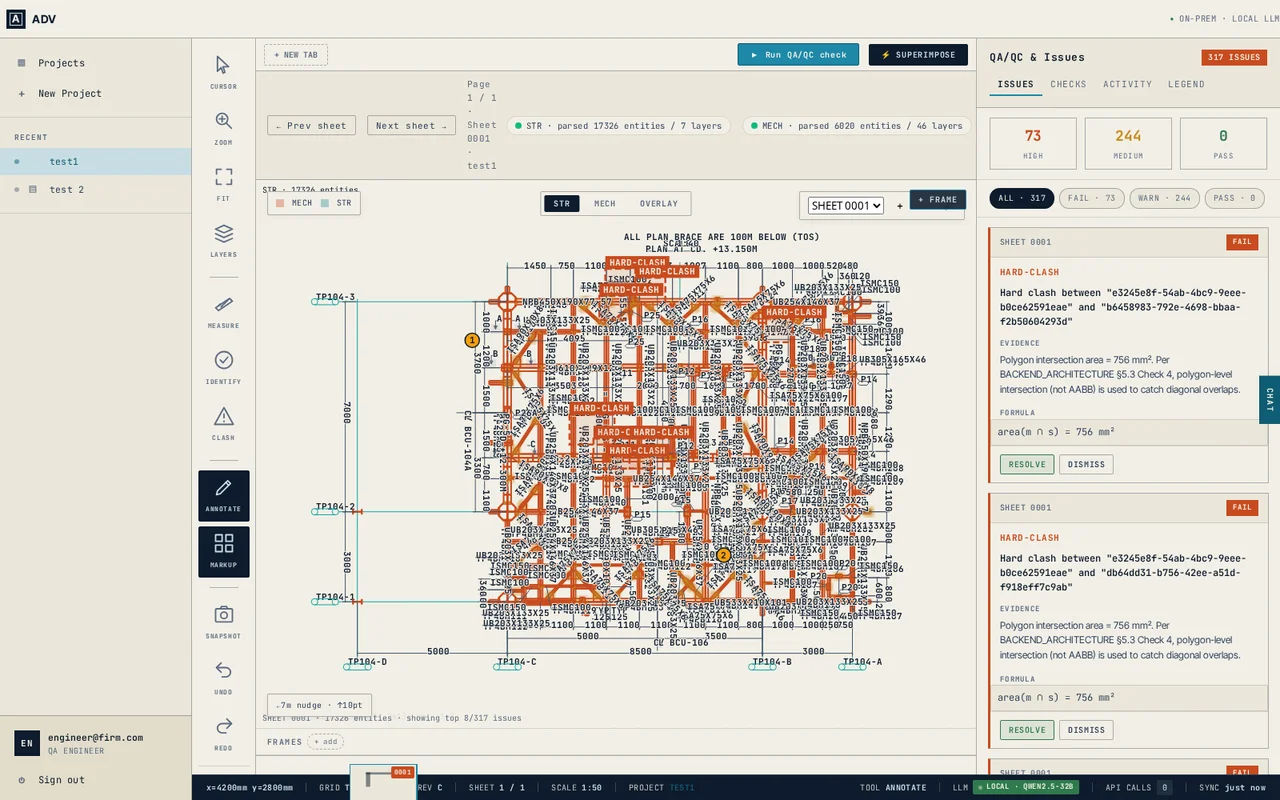
Two-phase CAD validation platform: a synchronous geometric rule engine plus an async LLM enhancement pass. Validates real General Arrangement drawings at scale.
// outcome
- 8
- 78
- 91%
- 1.8s
// problem
Manual review of structural and mechanical GA drawings is slow, inconsistent, and a bottleneck in heavy-engineering design cycles.
// approach
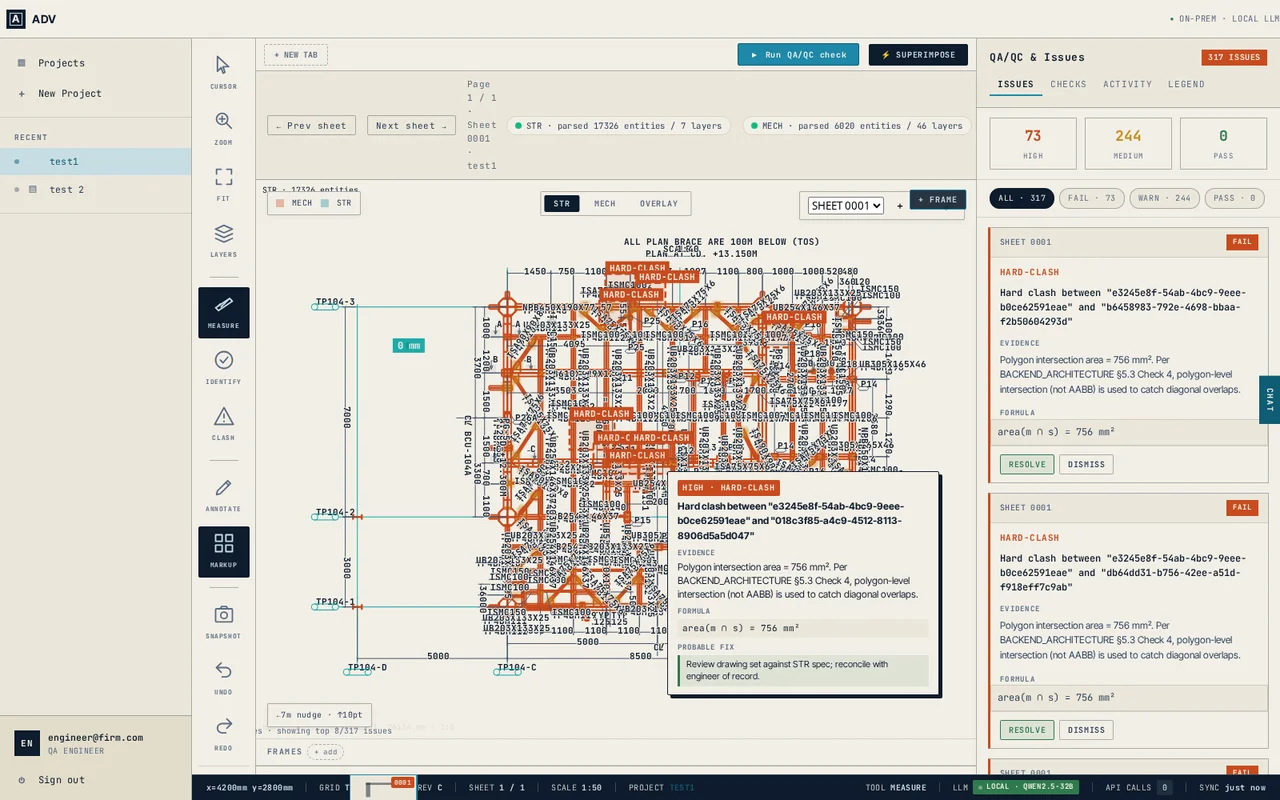
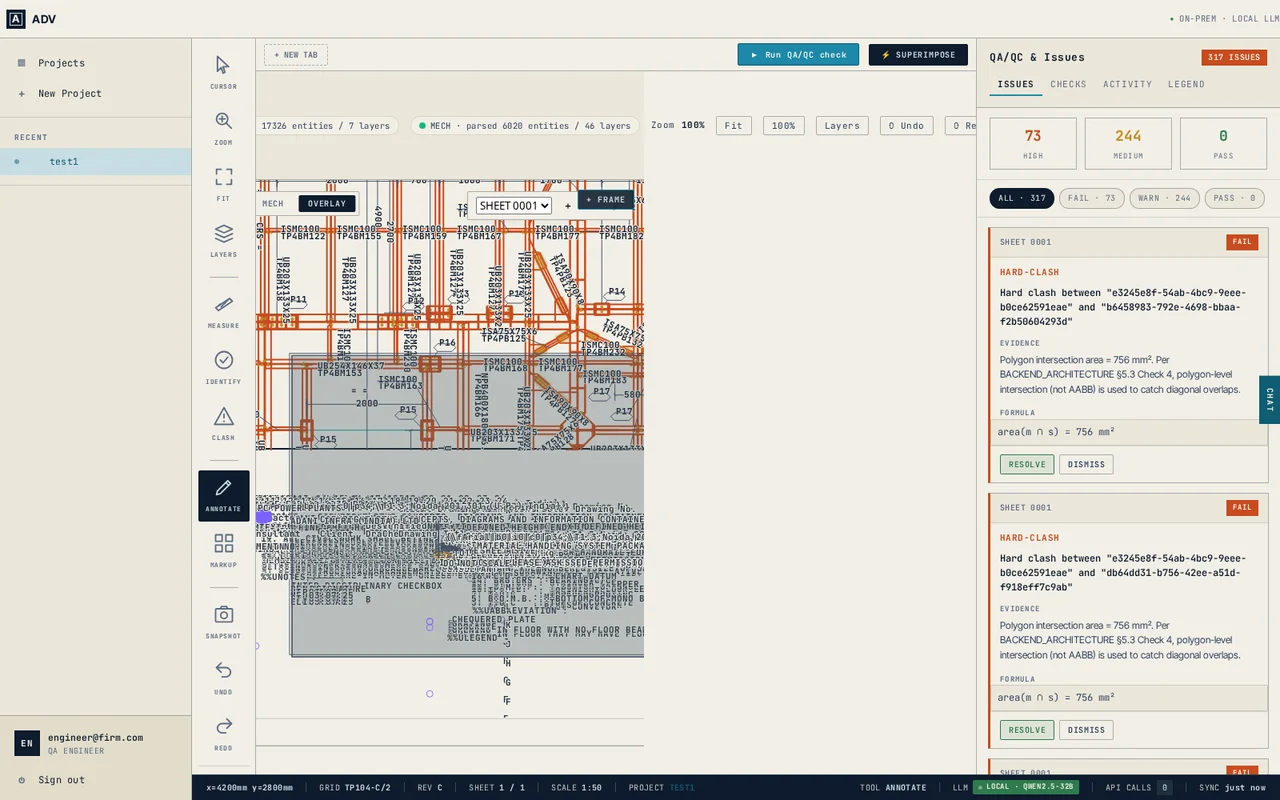
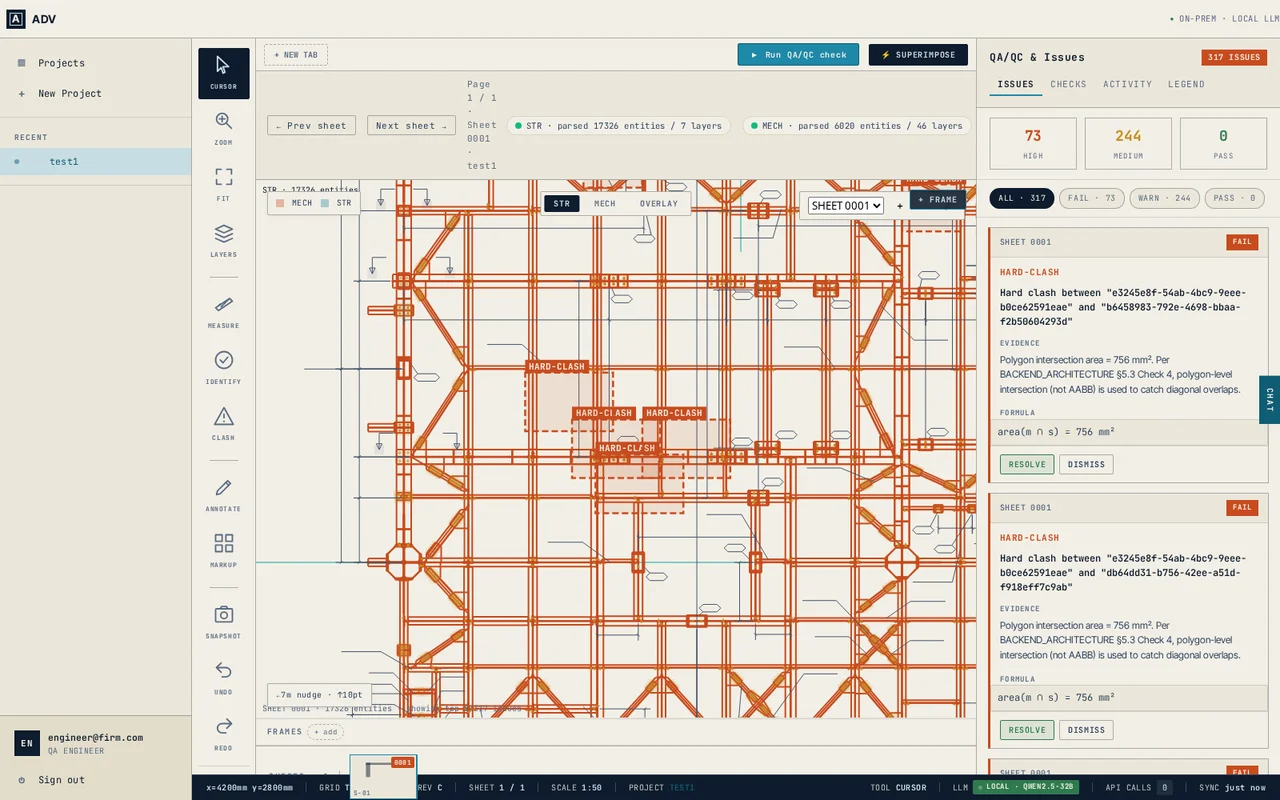
Decoupled Phase 1 (parsing + 8-rule Shapely/Hungarian/RapidFuzz engine, ~1.8s on a 7.4MB drawing) from Phase 2 (async LLM enhancement via Gemini/Ollama with a hard timeout).
// results
- 78 pytest cases, 91% statement coverage
- Phase 1 runs in ~1.8s on a real 7.4MB drawing (~17.8K entities)
- Semester-long industry engagement, sponsored by ISGEC Heavy Engineering
// screens
// in depth
Context
ISGEC Heavy Engineering produces large structural and mechanical General Arrangement (GA) drawings that historically required manual review by senior engineers. ADV replaces that review with a deterministic geometric rule engine layered with an LLM-assisted explanation pass, both gated by a strict latency budget.
What the rule engine does
Eight rules cover structural, dimensional, and ID-consistency checks. The hot path uses Shapely’s STRtree for sub-quadratic spatial indexing, a Hungarian-algorithm pass for 1:1 equipment matching, and RapidFuzz for fuzzy ID reconciliation. Together they catch the majority of mechanical-drawing defects that humans would normally flag.
Latency budget
Phase 1 (sync) targets 1.8s on real 7.4MB drawings. Phase 2 (async) runs as a background enhancement via Gemini or a local Ollama model and writes its findings to a separate report — never blocking the user.