IntelliCredit — Multi-Agent Credit Appraisal
India-Stack-native credit intelligence. A nine-node appraisal workflow — parallel spreading and GST verification, parallel reconciliation and buyer-concentration engines, then scoring, memo generation and counterfactual reasoning — built as a complete React front end over three fully worked borrower datasets.
// outcome
- 9
- 10
- 3
- ~11.9K
// problem
India's corporate loan appraisal takes 3–6 weeks and costs banks roughly ₹80,000 per file. Existing automation is shallow and, worse, unauditable: a score arrives with no way to trace a number back to the document it came from.
// approach
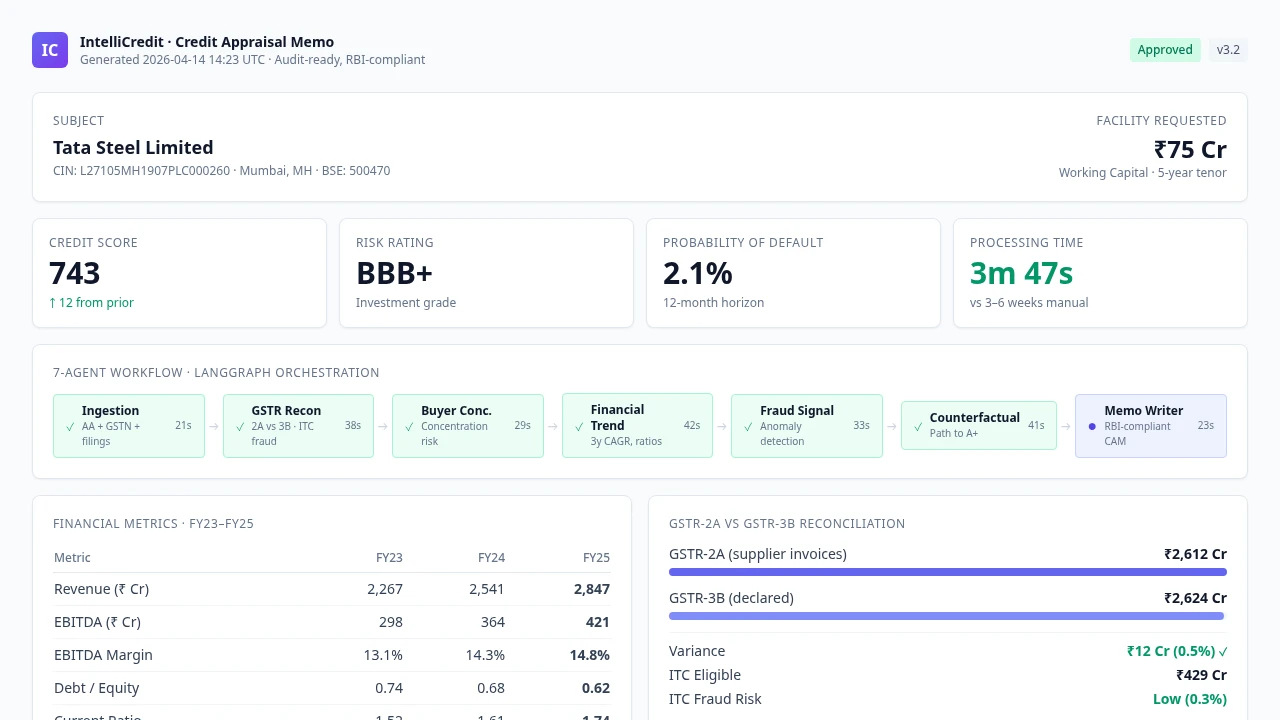
Modelled the appraisal as a graph of nine nodes with two parallel groups, and built the analyst-facing surface around it: a nine-quarter GSTR-2A vs GSTR-3B reconciliation, buyer-concentration analysis, twelve ratio cards with sparklines, a Chain of Evidence that carries document, page, extraction method and confidence on every figure, a promoter-intelligence network, and a counterfactual engine that prices the path from a decline to an approval.
// results
- Nine-node appraisal workflow with two parallel groups, surfaced as live per-agent progress
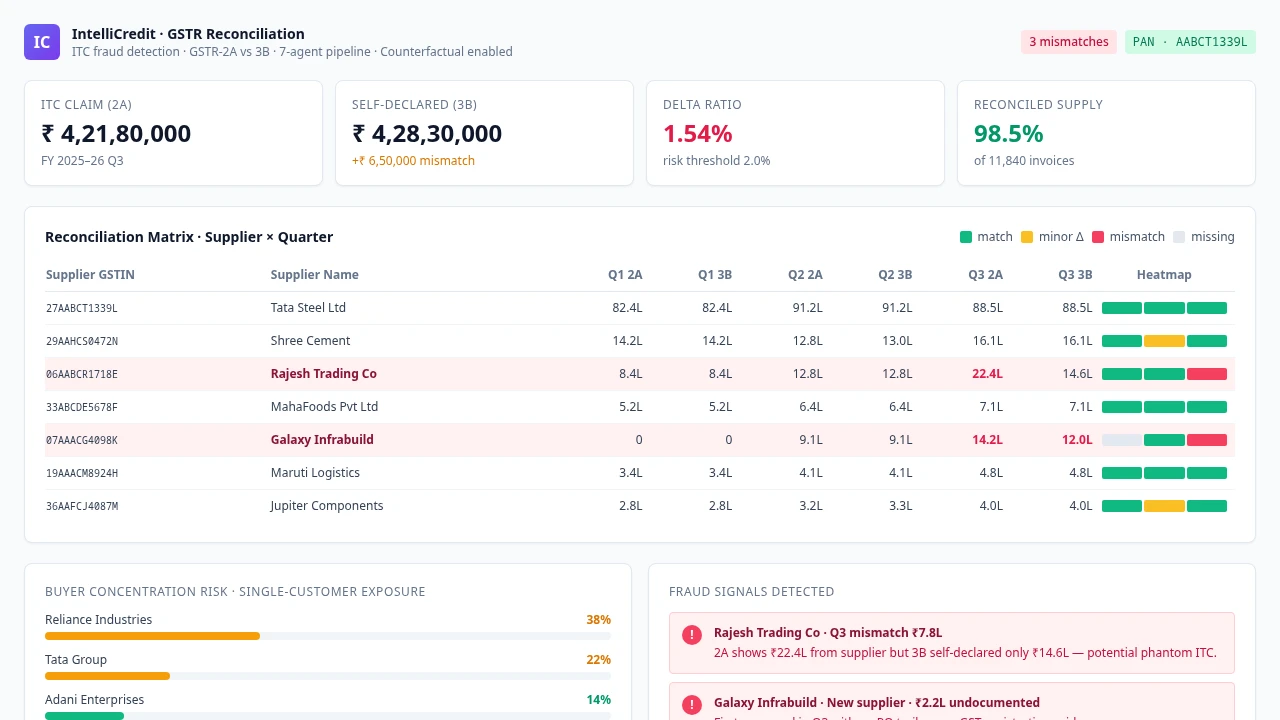
- Eight quarters of GSTR-2A vs GSTR-3B reconciliation per borrower, with variance and flagged quarters
- Chain of Evidence: document, page, extraction method and confidence on every ratio
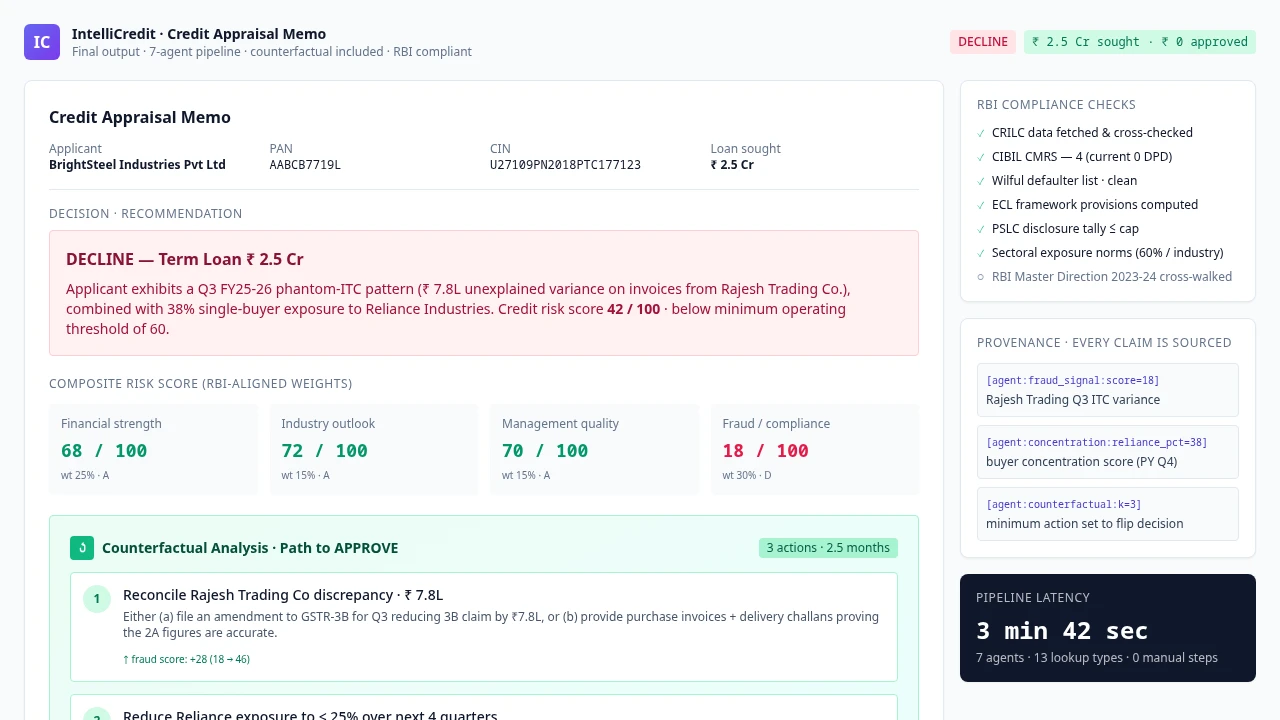
- Counterfactual engine that prices a path to approval — repay ₹3 Cr of term debt for +8 points, DSCR 1.25× to 1.5× for +11
- Audit trail typed by actor, with human override and compliance badges on every state change
// screens
// in depth
The appraisal is a graph, not a pipeline
Most of the work in a credit file is independent of the rest, and the sequence is wrong if you model it as a straight line. The workflow is nine nodes in two parallel groups:
doc_parse ──┬─ fin_spread ──┐
            └─ gst_verify ──┤
                           ├─► promoter_intel ─► risk_score ─► cam_gen
gstr_engine ┬─ buyer_engine ┘                          └─► counter_fact
Spreading and GST verification run together; reconciliation and buyer-concentration run together; everything downstream waits on both. The front end renders the graph as it runs, with per-agent progress, so the analyst watches the file assemble rather than staring at a spinner.
Reconciliation is the part that earns the file
The GSTR-2A vs GSTR-3B view is the core: eight quarters per borrower, each carrying the supplier’s claimed ITC against the invoice-level reality. The fraud dataset flags 5 of 8 quarters; the clean one flags none; the borderline one flags one. A flagged quarter is where a supplier’s claimed credit and their filed return disagree, and that disagreement is the thing a credit committee cannot see by reading a spreadsheet.
Chain of Evidence
Every ratio carries its own provenance — the document it came from, the page, the extraction method and a confidence score — and the UI renders that as a citation badge rather than a footnote. Twelve ratio cards per borrower, each with a four-point sparkline and a year-on-year delta, all of them traceable.
This is the difference between an automated score and an auditable one. A score with no provenance is a number a credit officer has to re-derive by hand; a score with provenance is a number they can defend.
Counterfactual reasoning
A decline is only useful if it comes with a way out. The counterfactual engine takes the appraisal and prices the changes that would flip it, each with its impact, difficulty and timeframe:
| Action | Impact | Difficulty | Timeframe |
|---|---|---|---|
| Repay ₹3 Cr of term debt — D/E 1.85× → 1.5× | +8 points | medium | 6 months |
| Cost optimisation — DSCR 1.25× → 1.5× | +11 points | hard | 9 months |
| Diversify buyers — top 3 below 35% | +6 points | medium | 12 months |
| Clear delayed MCA filings | +4 points | easy | 2 months |
The borrower gets a roadmap, not a verdict.
The audit trail is part of the product
Not a log file — a typed record. Every event carries an actor, an actor type
(ai_agent, human, system), an action type, the module it touched, a confidence, and the
previous and new value. Human overrides are first-class objects with their own workflow
stage and compliance badge. When a file is challenged, the trail answers who changed what,
when, and on whose authority.
Promoter intelligence
A D3 force-directed graph over promoter and counterparty relationships, with shell-company and NPA-linked nodes flagged. Promoter reputation is one of the strongest predictors in a credit file and one of the hardest to get at in a structured form.
The memo
The Credit Appraisal Memo is assembled in six sections — executive summary, business overview, financial analysis, promoter assessment, collateral assessment and risk mitigation — with the fraud dataset swapping in a fraud indicators section and the conditional dataset adding conditions for approval. Export is client-side jsPDF, with one module per section.
What is in the repository
The public repository is the front end: a React 18 + TypeScript + Vite SPA, roughly 11,900
lines across 10 routes and 12 page components, with about 1,800 lines of worked data for
three borrowers — an approve, a fraud and a conditional case — and a DatasetContext that
switches between them. BACKEND_INTEGRATION_SPEC.md documents the service architecture this
surface is built against; the specification is explicit that the shipped data path is demo
mode, and the front end is written against the typed contracts that mode will replace.