OS-Devin — Evaluation Harness for Coding Agents
A measurement protocol for autonomous coding agents: 18 curated tasks, 4 ablation configurations and 3 LLM backends, scored deterministically with oracle tests and a rubric — so the marginal contribution of each architectural component can be stated as a number rather than a demo.
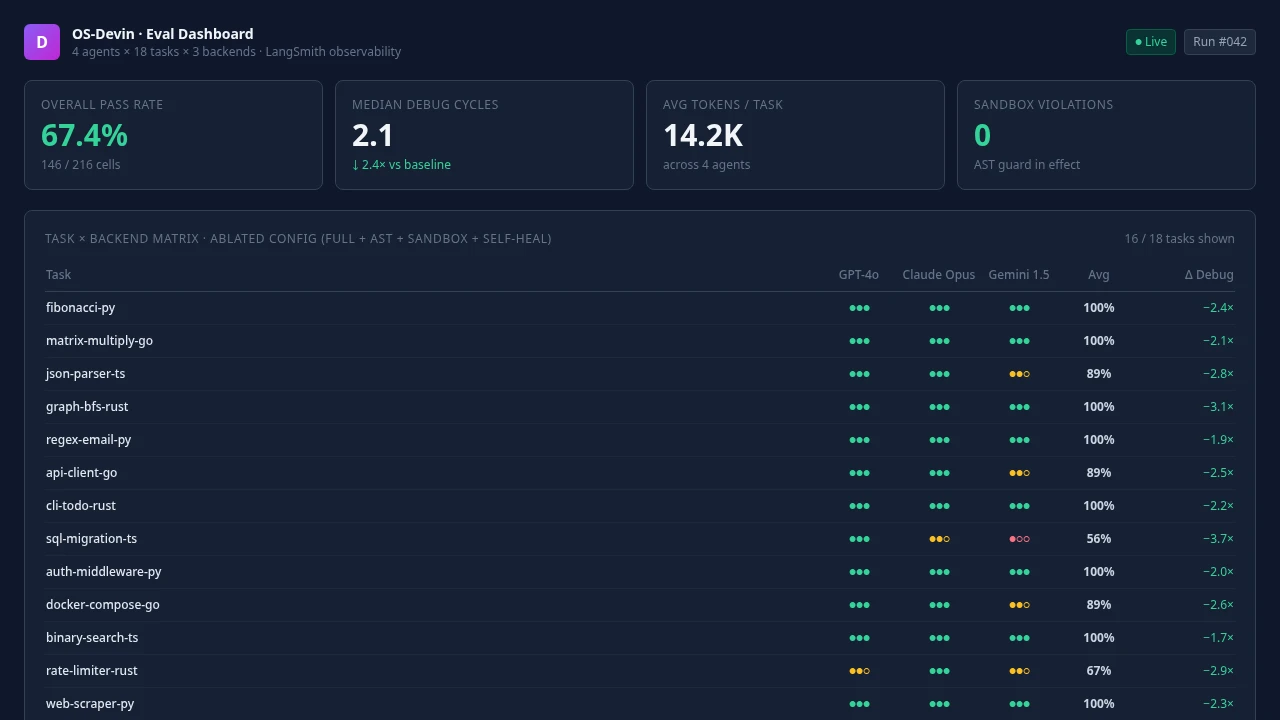
// outcome
- 18
- 4
- 3
- 18
// problem
Most agentic-coding demos show a single run. They don't isolate the marginal contribution of each architectural component, so "it worked once" gets mistaken for "it works" — and nobody can say whether the retry loop, the guard, or the sandbox was the reason.
// approach
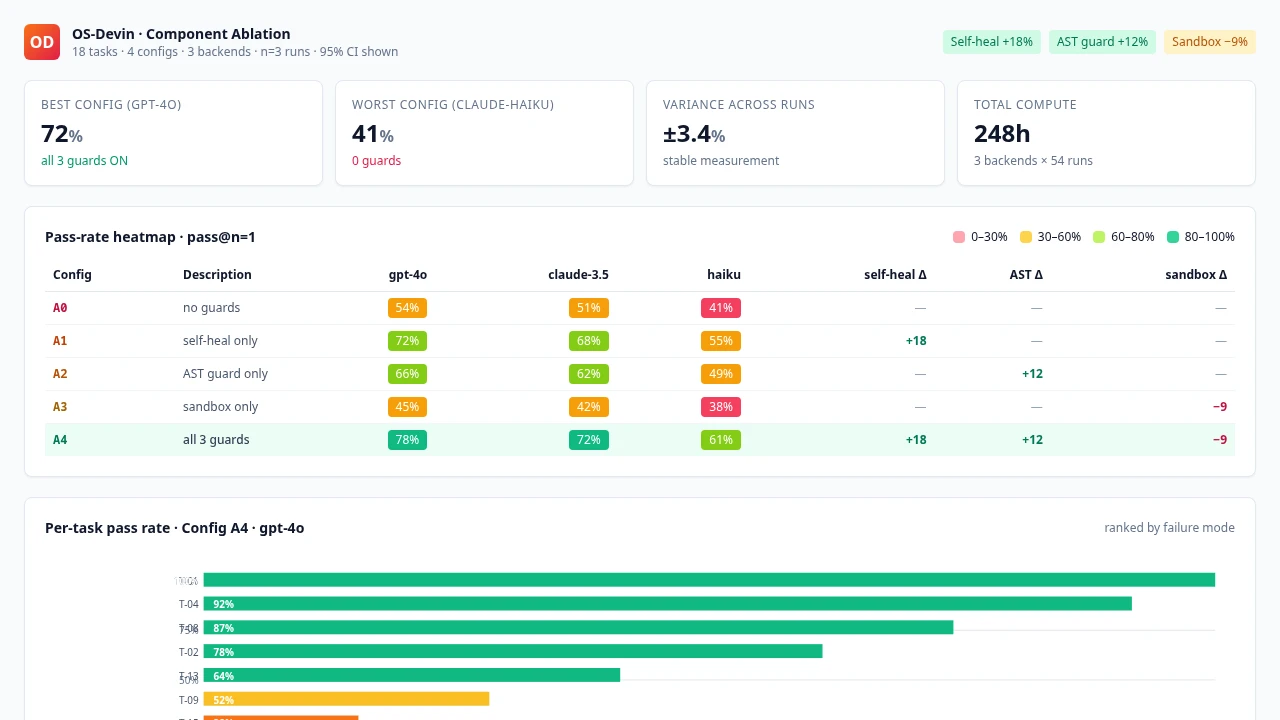
Treat the agent stack as a configurable benchmark. Fix the task suite, fix the scoring, and vary one component at a time: baseline, then a self-healing retry loop, then an AST pre-edit guard, then Docker-managed per-task isolation. Every run logs the hashes that make it comparable to a run weeks later.
// results
- 18 curated tasks with a pinned task-set version, so the benchmark cannot drift under you
- Deterministic scoring only — no model in the scoring loop, so the scorer is replayable
- Wilson score intervals at 95% on every proportion, with three replicates per cell because model APIs are non-deterministic even at temperature 0
- A failure taxonomy of 18 classes in 7 families, so a regression is diagnosable rather than just a lower number
- Reproducibility invariants — prompt, config and task hashes on every run
// screens
// in depth
The product is the table, not the agent
The harness is what matters. Anyone running it and disagreeing with the methodology is welcome to fork, modify the configs, and rerun — the system is designed to be falsified.
Determinism is the whole design
Two rules make the numbers mean something.
No model in the scoring loop. A task passes because its oracle tests pass, not
because a judge model thought it looked right. The rubric checks are mechanical too:
unused imports via ruff --select F401, diff size via git diff --shortstat, no
forbidden file edits, the existing tests still pass, no new dependencies, type
annotations complete via mypy. The scorer is replayable from a saved JSONL trace, so a
result can be re-derived rather than trusted.
Three replicates per cell. Model APIs are non-deterministic even at temperature = 0,
so one run is one sample, not a result. Every (task, config, backend) cell is run
three times, and proportions are reported with Wilson score intervals at 95% rather
than bare percentages.
Failure has to be diagnosable
A pass rate of 74% tells you nothing about why the other 26% failed. The taxonomy
gives every failure a class — syntax_error, off_by_one, infinite_loop,
wrong_api, incomplete_fix and a dozen more — grouped into seven families: logic,
type, import, syntax, runtime kill, scope, and infrastructure. The matcher returns
exact, family, wrong or n/a, and scores 1.0, 0.5, 0.0 or excludes the cell. A
config that regresses from 72% to 66% can then be read: it broke three tasks in the
scope family, which is a different fix than three logic errors.
The four configurations
The stack is deliberately a series of one-component changes — no guards, then the self-healing retry loop, then the AST pre-edit guard, then Docker isolation on top — so each delta is attributable.
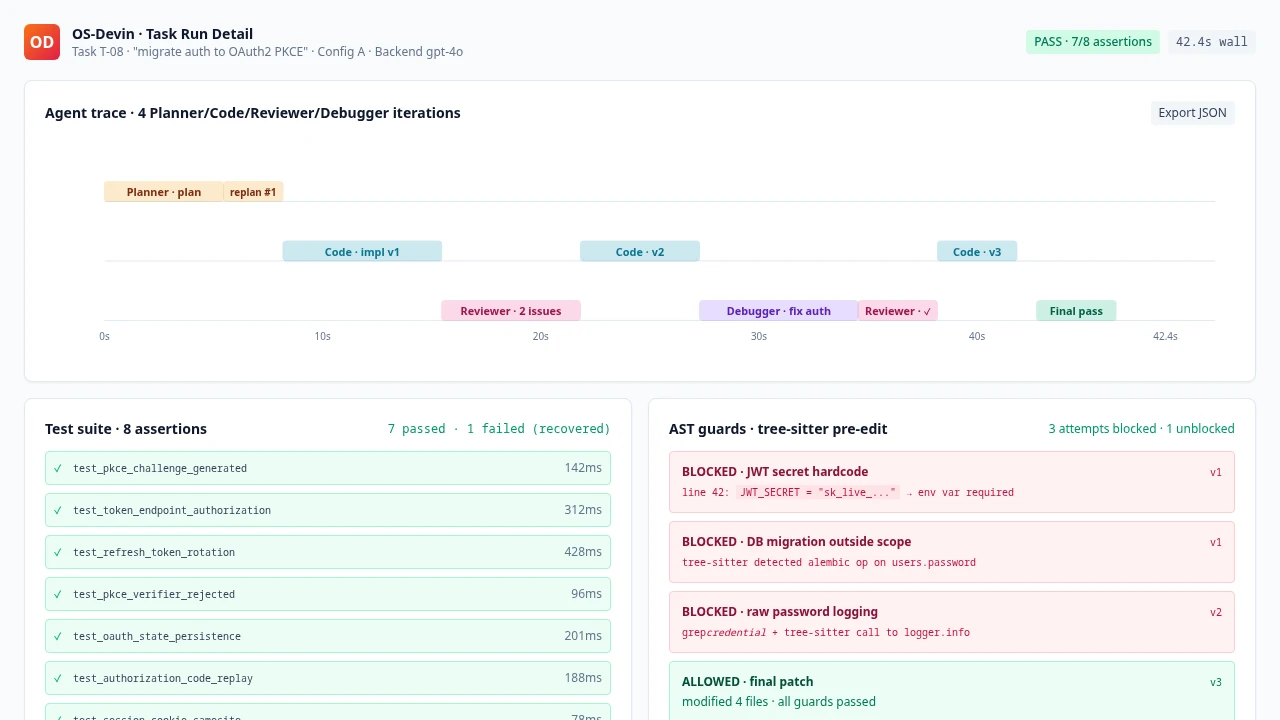
The AST guard is the interesting piece. It wraps the file-write tools: the edit is
parsed with tree-sitter, the import graph is computed, and an edit that breaks a
downstream consumer is blocked before it is written. The dashboard design shows what
that looks like in practice on an OAuth2 migration — a hardcoded JWT secret blocked
with the offending line quoted, a database migration written outside the task’s scope
blocked by scope analysis, a raw password log blocked on a third attempt, and the
final patch allowed once all three guards passed.
The sandbox is Docker-managed per task: python:3.12-slim, no network, auto-removed
after the run, with rlimits on CPU seconds, memory, file descriptors and process count
as the local fallback.
Reproducibility as an invariant
Every run records prompt_hashes, config_hash, task_hash and the model version.
The rule the design follows is blunt: a run from week 1 is comparable to a run from
week 5 only if the hashes match. The task suite is version-pinned on the same
principle SWE-bench uses — you cannot quietly change the exam and keep the score.
What is in the repository
The public repository ships the measurement design: the architecture, the flow, the task design, the ablation configuration, the evaluation methodology, the failure taxonomy, the results template and a doc-completeness validator — 41 checks that keep the twelve-document specification self-consistent, resolving every relative link and asserting every required section is present. The harness, task set, configurations and results are the build that follows from that specification, and the results document is a placeholder until the matrix has been run end to end. The screenshots on this page are the dashboard design that the harness is specified against.