AfterMath — On-Call SRE Agent with Memory
An SRE diagnosis agent that recalls similar past incidents from a memory bank, proposes evidence-cited mitigations, refuses fixes that have backfired before, and decays confidence as a fix stops working. The confidence score is computed from memory metadata — the model never supplies it.
// problem
When a service breaks at 3 a.m., the on-call engineer is alone with a wall of alerts, and the lesson from the last time this happened lives in a Slack thread nobody can find. A generic incident bot has no memory of what actually worked at your shop, and it will cheerfully recommend the fix that failed last Tuesday.
// approach
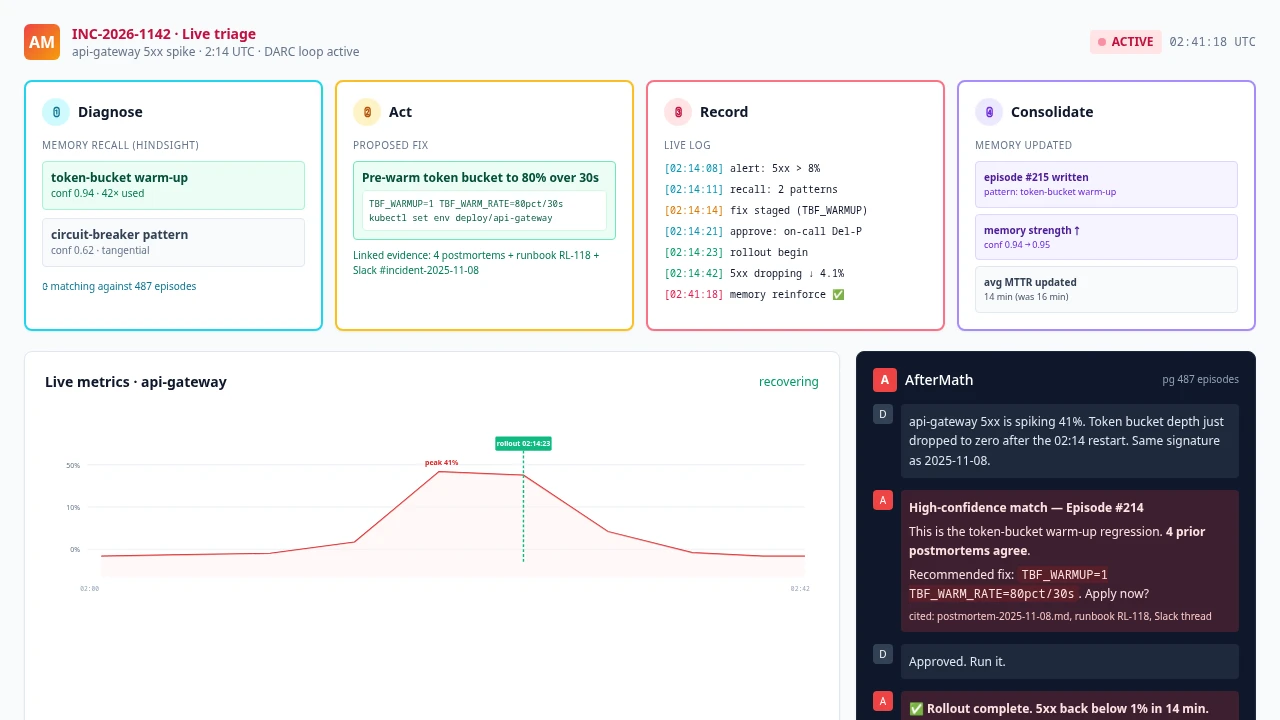
A DARC loop — Diagnose, Act, Record, Consolidate — over a Hindsight memory bank. Recall similar incidents, reason over them with a cautious senior-SRE persona, and compute the confidence of the recommendation from the recalled evidence rather than asking the model to self-report it.
// results
- Confidence computed from memory metadata across four factors — the model never supplies the number
- A measured 71 → 32 confidence collapse when a mitigation starts failing, with the weakening trend applied
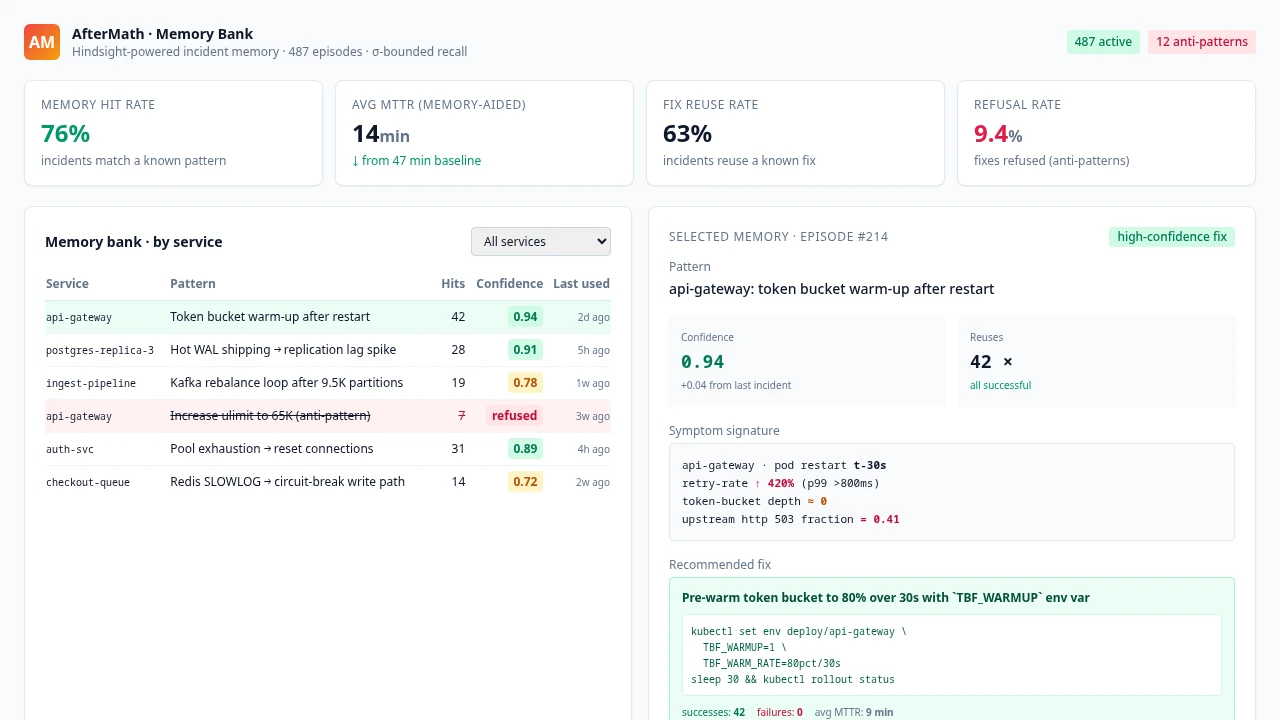
- A do-not-do list: mitigations with a recorded failure are surfaced and explained, not repeated
- Provenance filtered down to the incidents that were actually recalled
- A memory-free baseline control that returns the same agent's answer with confidence 0, so the memory can be measured rather than assumed
// screens
// in depth
Memory is the product
Generic incident bots hallucinate with no memory of what actually happened at your company. AfterMath’s whole point is that it does, and that the memory is earned — the same incident resolved a hundred times should make the next one sharper, and the same mitigation that stopped working should stop being recommended.
The seed corpus is eleven resolved incidents across four pattern clusters, and the architecture is built so the next one can be added.
DARC
Diagnose — the agent recalls similar incidents from the memory bank and reasons over them. Act — a human applies the fix; the agent does not touch production, and the code says so. Record — the outcome goes back into memory as a first-person experience fact. Consolidate — the memory bank merges the new fact into the pattern cluster it belongs to.
The flow through the API is deliberately simple: POST /api/diagnose takes a symptom,
truncates it, and either takes the memory-free path or runs the full recall → reason →
assemble → score pipeline. The response carries the root cause, the recommended fix, the
list of mitigations to avoid, the supporting incident IDs, the computed confidence, a
freshness warning, and the evidence itself.
The confidence score is computed, not claimed
This is the part that matters. The model is never asked how sure it is. The score comes out of the recalled memory:
successRatio    = s / (s + f)                       # resolved vs. failed
evidenceFactor  = min(1, n / 3)                      # 3+ incidents = full weight
freshnessFactor = { stable 1.0, strengthening 1.0,
                    weakening 0.5, stale 0.6 }
recencyFactor   = clamp(1 − daysSinceLastEvidence / 90, 0.4, 1.0)

confidence = round(100 × successRatio × evidenceFactor
                      × freshnessFactor × recencyFactor)
Bands: ≥70 high, 40–69 medium, below 40 low. With no supporting incidents at all the score is forced to zero and the result is marked unverified — the agent is allowed to say “I don’t know” and the arithmetic makes sure it does.
A mitigation that stops working loses the room
Freshness is derived from the evidence trail, not asserted. If the last two pieces of evidence for a pattern are both failures, the trend is weakening and the freshness factor halves. If the newest evidence is more than 60 days old the trend is stale. Otherwise it is stable or strengthening.
The effect is measurable. The pre-migration rate-limit cluster — four successes, no failures, stable, 26 days old — scores 71. Add two failures and the trend flips to weakening: the same cluster now scores 32, a low band recommendation. Nothing about the fix changed; the memory changed.
| Cluster | n | s / f | Freshness | Score |
|---|---|---|---|---|
| Pre-migration rate-limit | 4 | 4 / 0 | stable | 71 |
| Database | 2 | 2 / 0 | stable | 53 |
| Rate-limit | 6 | 4 / 2 | weakening | 32 |
| Memory | 2 | 1 / 1 | stable | 18 |
| TLS | 1 | 1 / 0 | stable | 15 |
Refusing a fix that has already failed
Two mechanisms, and both are driven by the same memory. First, an explicit do-not-do list: if a mitigation has any recorded failure, it is surfaced with an explanation of when and why it failed, rather than being quietly proposed again. The seed makes it concrete — restarting pods is a recorded failure, adding an LRU cache is a recorded success.
Second, the arithmetic does the same work quietly: successRatio falls as failures
accumulate, and once the trend flips to weakening the freshness factor halves on top of
that.
Provenance you can check
Every step of the recommended fix carries the incidents that support it, and the supporting incident list is filtered down to what was actually recalled for this symptom. The response ships the evidence entries themselves — incident ID, date, outcome, root cause, resolution, MTTR — so the engineer can read the history rather than a summary of it.
The control case
The API takes a use_memory flag. With it off, the same agent answers from the model
alone: no recall, confidence forced to zero, marked unverified, no evidence. That is the
control — it makes the memory’s contribution measurable instead of assumed, and it is how
you find out whether the agent would have said the same thing anyway.
The agent’s persona is deliberately cautious — skepticism 4, literalism 5, empathy 2 on a five-point scale, with the operating principle that evidence outranks instinct. It sees masked account identifiers and a small sample of transactions, never the raw corpus.
Scope
The corpus is eleven seed incidents and the pattern clustering is four clusters; the repository’s own documentation notes five, and the clustering as implemented yields four. Seventeen backend tests run against the confidence arithmetic and the recall path.
Consolidation is delegated to the memory bank’s own asynchronous merge rather than implemented locally, and the automatic re-scheduling of a rejected recommendation is roadmap rather than shipped. The frontend carries a separate mock corpus for the demo surface; the backend corpus is the seed set above.