SAR-AI — Multi-Agent AML Compliance
Five-agent Suspicious Activity Report (SAR) narrative generator with a per-sentence evidence panel. A deterministic Fact Checker re-reads every generated sentence, scores each claim against the database, and marks the ones a human must review.
// problem
AML SARs are written by analysts under deadline pressure. The result is inconsistency, speculation, and — the part that matters later — no audit trail back to the underlying evidence. When a filing is challenged, the analyst has to reconstruct the reasoning by hand.
// approach
Five agents in sequence over a six-table schema: a Data Analyst that runs the aggregate SQL and flags five suspicious patterns, a Compliance Specialist that classifies the typology against seven FinCEN activity codes, a Narrative Writer, a Fact Checker, and an Editor. The Fact Checker is the important one — it is not a model at all.
// results
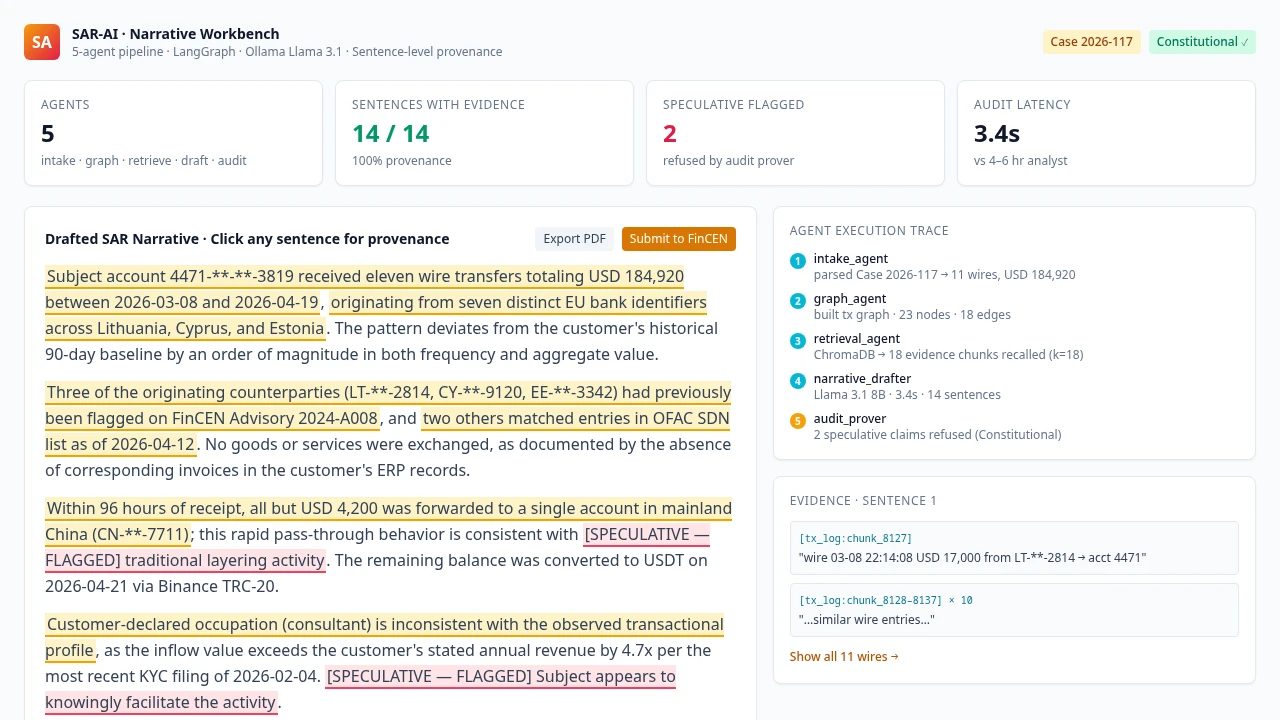
- Click any sentence to open an evidence panel: the SQL, the query results, and a per-claim confidence bar
- Five regex claim types extracted from every generated sentence — numbers, INR amounts, dates, account references, FinCEN codes
- Claims scored against database aggregates with a 1% tolerance; unresolved claims are capped and flagged for review
- Six hand-written transaction-graph detectors: collection, high-risk jurisdiction, layering, structuring, round-trip and rapid activity
- Six curated FinCEN / FATF / PMLA reference documents injected into the generation prompt
// screens
// in depth
Why per-sentence provenance
A regulator does not ask whether the document is trustworthy. They ask about the assertion. If a filing says ₹9,889 was deposited on 30 January, the question is which deposit, not whether the system is generally reliable. So the unit of audit in this system is the sentence.
Each sentence in the narrative is clickable, and the panel behind it carries the SQL that was run, the rows it returned, a confidence bar, and the verdict on each individual claim the sentence makes.
The five agents
| # | Agent | Uses a model? | Job |
|---|---|---|---|
| 1 | Data Analyst | No | Pull the alert and customer, run the aggregate SQL, flag five suspicious patterns |
| 2 | Compliance Specialist | Ollama, rule-based fallback | Classify the typology and assign the FinCEN activity code |
| 3 | Narrative Writer | Ollama, template fallback | Draft the narrative, then apply the constitutional checks |
| 4 | Fact Checker | No | Extract the claims, verify each one, annotate what needs review |
| 5 | Editor | Ollama, rule-based fallback | Grammar and style only — no new information |
The orchestration is a plain async sequence with a progress callback in fixed bands (0–20 / 20–40 / 40–70 / 70–90 / 90–100 %), and the front end polls the task endpoint once a second to draw the progress bar.
Every model call has a rule-based fallback, so the pipeline degrades in quality rather than failing outright.
The Fact Checker is the point
The Writer is allowed to generate freely — it sees only a small sample of transactions and only the last four digits of any account number. What it is not allowed to do is assert something unsupported.
So after generation, a second pass re-reads the text and pulls out five kinds of claim with regular expressions: numbers, currency amounts (with Indian lakh/crore parsing), dates, account references, and FinCEN activity codes. Each is then checked against the database:
- Numbers against the transaction count, the distinct source count and the sentence count, within 1% relative tolerance.
- Currency against the aggregate total.
- Dates against the transaction date range — exact is 1.0, inside a 30-day buffer is 0.85, outside it is 0.3.
A sentence’s confidence is the minimum across its claims, and a claim that cannot be matched at all returns 0.5 — which means any sentence containing an unmatched number or an account reference is flagged rather than trusted.
Below 0.70 the sentence is marked [REVIEW REQUIRED: Confidence NN%]; between 0.70 and
0.95 it gets a [*]. Those markers persist into the final narrative and into the
exported PDF, so the analyst sees exactly which sentences need a human.
The constitutional principles
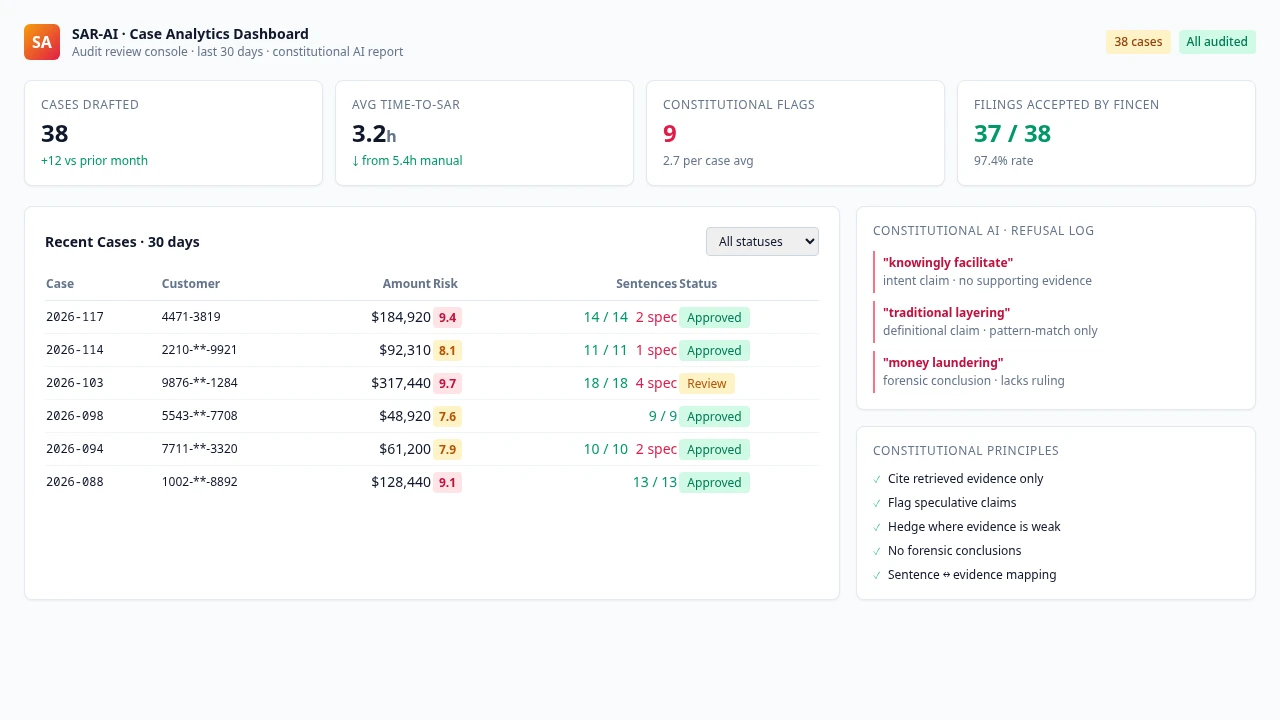
Five principles govern what the narrative may assert, each with a severity:
| Principle | Enforcement |
|---|---|
| Only state facts supported by transaction data | Checked downstream by the Fact Checker |
| Do not speculate about customer intent | Banned phrases: appears to be, seems like, probably, might be, clearly trying to |
| Use formal regulatory language | Banned words: shady, sketchy, weird, fishy, bad |
| Include specific dates, amounts, account numbers | Checked downstream by the Fact Checker |
| Cite FinCEN activity codes | Required by the prompt |
The two rules that can be checked mechanically are checked by the Fact Checker rather than the Writer, which keeps the Writer from having to police its own output. The writer’s own enforcement is a filter that strips the banned phrases and formalises contractions — and the Editor’s instruction is explicit that it must not add information, change amounts or alter dates.
The transaction graph, without a graph library
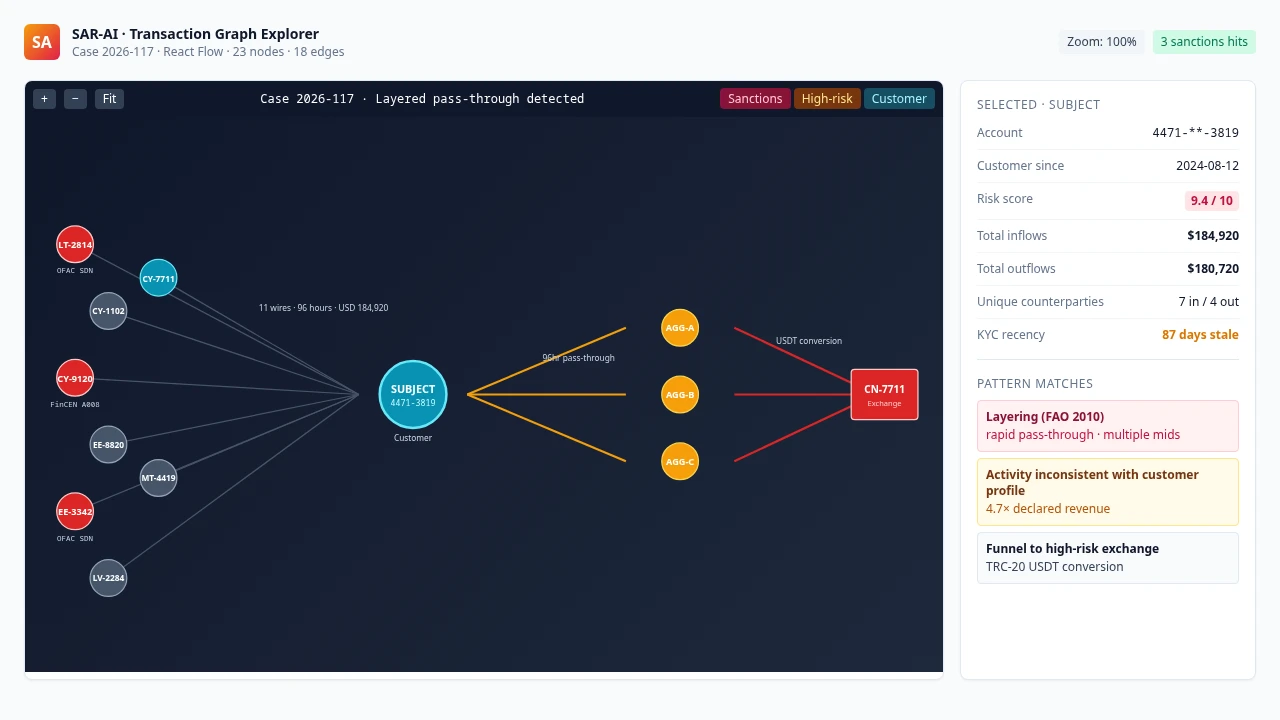
The graph is built from plain dicts rather than a graph package, and the analysis is six hand-written detectors:
| Detector | Rule |
|---|---|
| Collection pattern | More than 10 distinct inbound sources to the subject account |
| High-risk jurisdiction | Any node in a flagged offshore jurisdiction |
| Layering | Same-day or next-day outbound ≥50% of that day’s inbound, over ≥3 instances |
| Structuring | Amount inside the 85–99% band below the CTR threshold, across ≥3 transactions |
| Round-trip | Accounts that both sent to and received from the subject |
| Rapid activity | 5 or more transactions inside 24 hours |
Node labels carry only the last four digits of an account number, and the React Flow view lays the graph out on a fixed five-column grid — edges coloured and weighted by amount, the subject account in blue and anything high-risk in red.
Regulatory context
Six curated reference documents — FinCEN guidance on structuring, layering, collection and rapid movement, FATF Recommendation 20, and India’s PMLA 2002 — are injected into the generation prompt, scoped to the typology the Compliance Specialist assigned. Seven FinCEN typologies are supported, each with its activity code.
Schema
Six tables: customers, alerts, transactions, sars, audit_logs and
knowledge_docs. The audit table is the one that matters — it is keyed on
(sar_id, sentence_index, entry_type), and three rows are written per sentence: the
sql_query, the fact_verification and the llm_generation record.
The seed database carries ten customers, ten alerts and 240 transactions worth about ₹18.3 Cr, across collection, structuring, layering and rapid-movement scenarios.
Scope
The pipeline, the evidence panel, the graph and the detectors are implemented and runnable. The audit rows are written per sentence against the aggregate query the Data Analyst ran — they are a genuine evidence trail, but they are not a row-level link from a sentence to specific transaction IDs, and the design docs treat that as the next step rather than a shipped feature.