SignHear — Real-Time Voice-to-Sign Translator
Cross-platform Edge AI app that translates spoken English to animated SignWriting in real time — fully offline. Built for the Snapdragon X Elite track. Whisper for STT, a local SignWriting model, and an optional Groq/LLaMA simplifier for online mode.
// problem
Deaf and hard-of-hearing users need low-latency access to spoken content without depending on cloud round-trips for every phrase.
// approach
Whisper for on-device STT, a local PyTorch SignWriting model, optional Groq/LLaMA sentence simplification in online mode, and a Tauri-based desktop shell that runs offline by default.
// results
- All core AI runs locally
- Cross-platform: Windows, macOS, Linux, Snapdragon X Elite
- Edge AI consumer utility track (Snapdragon X Elite)
// screens
// in depth
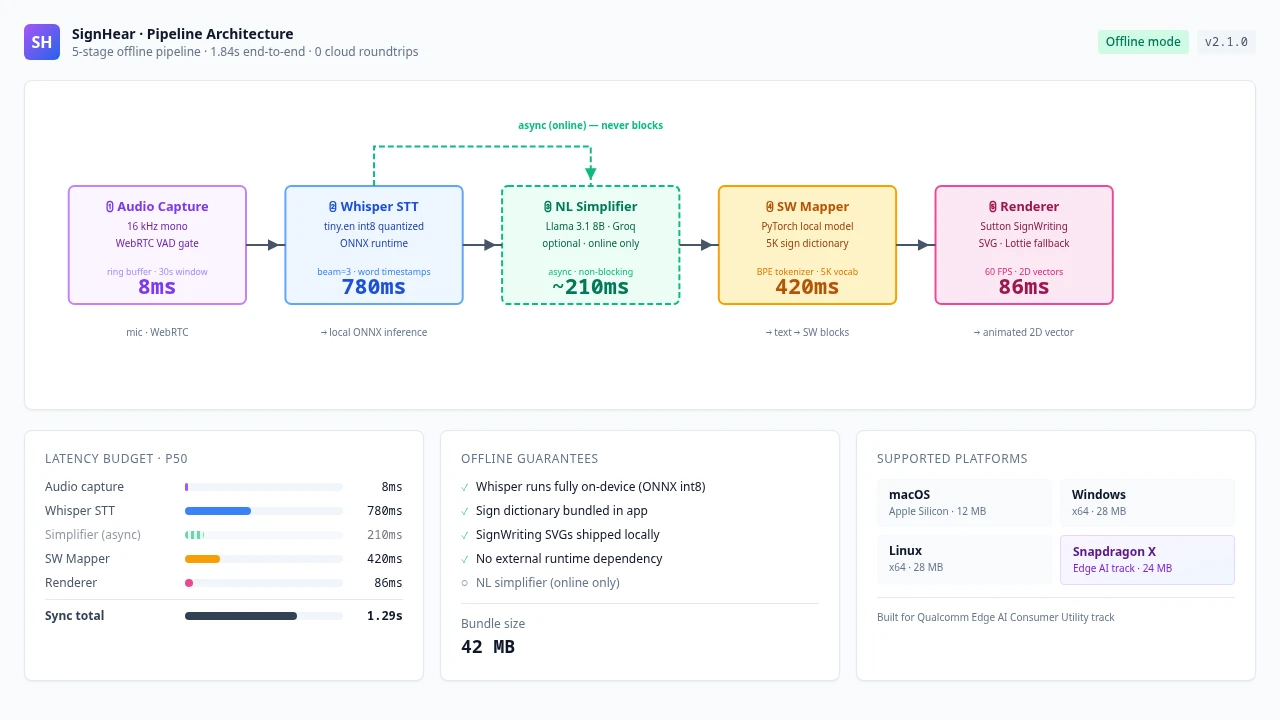
The pipeline is the product
Translating speech into sign is not one model — it is a chain of five, and the design question is which stage is allowed to need the network.
| Stage | Model / method | Role | P50 |
|---|---|---|---|
| Audio capture | 16 kHz mono, WebRTC VAD gate, 30 s ring buffer | Frame the utterance | 8 ms |
| Whisper STT | tiny.en int8, ONNX Runtime, beam 3 + word timestamps | Spoken English → text | 780 ms |
| NL simplifier | Llama 3.1 8B via Groq — optional, online only | Rewrite into signable phrasing | ~210 ms |
| SW Mapper | PyTorch local model, 5K sign dictionary, BPE tokenizer (5K vocab) | Text → SignWriting blocks | 420 ms |
| Renderer | Sutton SignWriting, SVG with Lottie fallback, 60 FPS, 2D vectors | Blocks → animated sign | 86 ms |
Sync total 1.29 s; 1.84 s with the simplifier in the loop. The simplifier is the only stage that reaches the network, and it is async and non-blocking — it never gates the sign. Turn on offline-only mode and there are zero cloud round-trips.
What “offline” actually means
The guarantees are enumerated rather than assumed:
- Whisper runs fully on-device — quantised to int8 and executed through ONNX Runtime.
- The sign dictionary is bundled into the app; no lookup call leaves the machine.
- SignWriting SVGs ship locally, so rendering does not fetch glyphs.
- No external runtime dependency.
- The NL simplifier is the single online exception, and it is optional.
Bundle size is 42 MB. It builds for macOS on Apple Silicon (12 MB), Windows and Linux on x64 (28 MB each), and Snapdragon X (24 MB) — built for the Qualcomm Edge AI Consumer Utility track.
Reading the output
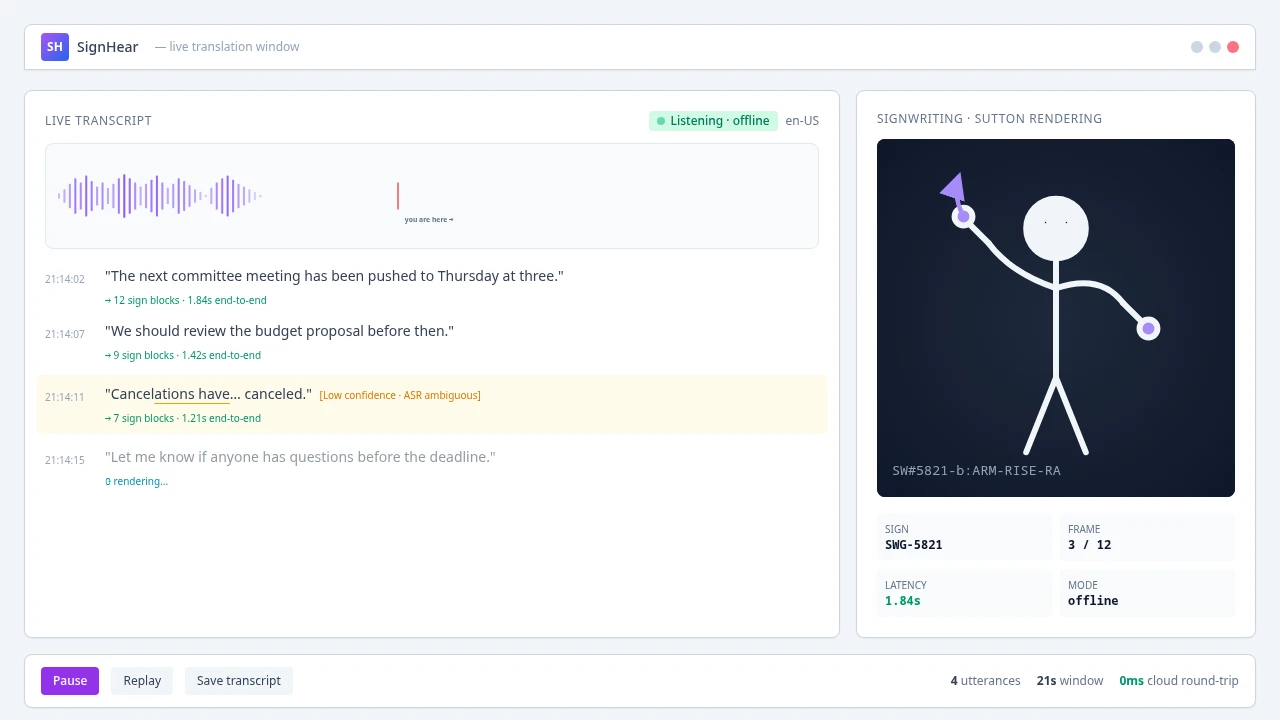
The live transcript carries a sign-block count and an end-to-end latency per utterance, so
you can see why something was slow. When the recogniser is not sure, the line is flagged
rather than quietly rendered — "Cancellations have... canceled." comes back as
low confidence, ASR ambiguous, which is the difference between a sign the user can
trust and one they cannot.
The renderer shows the sign string it is drawing (SW#5821·b·ARM-RISE·RA), the sign ID, the
frame counter within the sign, and whether the app is in offline mode.
Languages
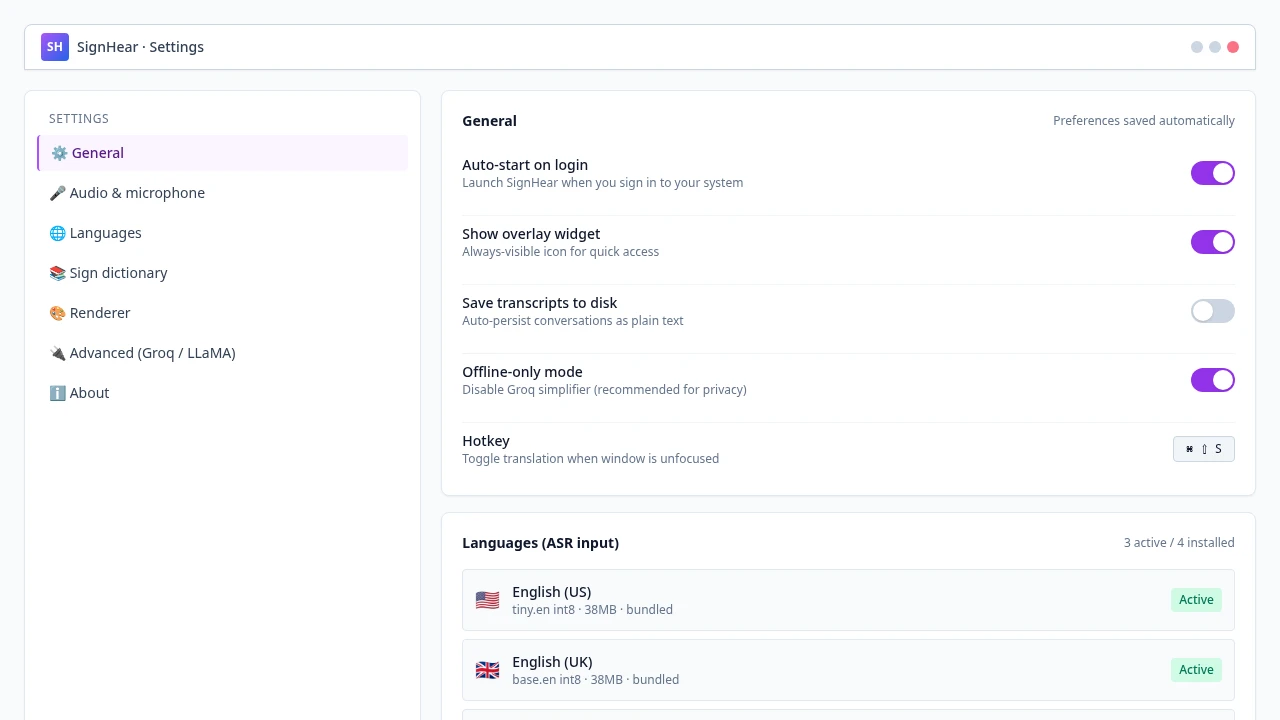
Four ASR languages installed, three active. English (US) runs tiny.en int8 and English (UK)
runs base.en int8, both 38 MB and both bundled; the models ship with the app rather than
being downloaded on first use, so the app works on a machine that has never seen a network.
Status
Repository link intentionally withheld until the project is made public.