NHAI Netra — Road Defect Computer Vision
React Native (Expo) field app for on-device road-defect detection using TFLite + vision-camera, with an admin recharts dashboard for analytics.
// problem
National highway agencies need consistent pavement condition data, but manual surveys are slow and inconsistent.
// approach
On-device inference (TFLite via react-native-fast-tflite, fed frames from react-native-vision-camera), shared zod contracts between the mobile app and the admin dashboard, recharts for the analytics layer.
// results
- Real-time on-device inference on commodity Android hardware
- Admin dashboard with recharts visualizations
- Shared type-safe contracts via zod
// screens
// in depth
Offline-first, because the network is not always there
A field surveyor checking attendance on a highway project is often somewhere the cellular signal is poor and the work still has to be recorded. So the app writes to a local, tamper-evident ledger first and syncs when it can — the record never depends on the network being up at the moment of capture.
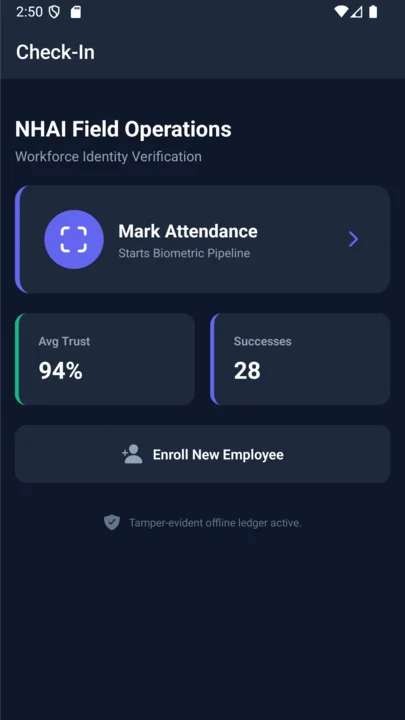
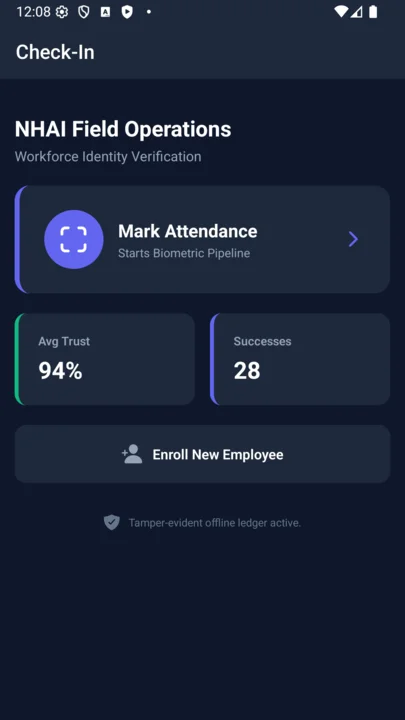
The check-in screen is the whole flow in one view: start the biometric pipeline, and the running averages sit next to it — 94% average trust and 28 successes so far, with enrolment of a new employee as a separate action rather than an implicit side effect of checking in.
The ledger
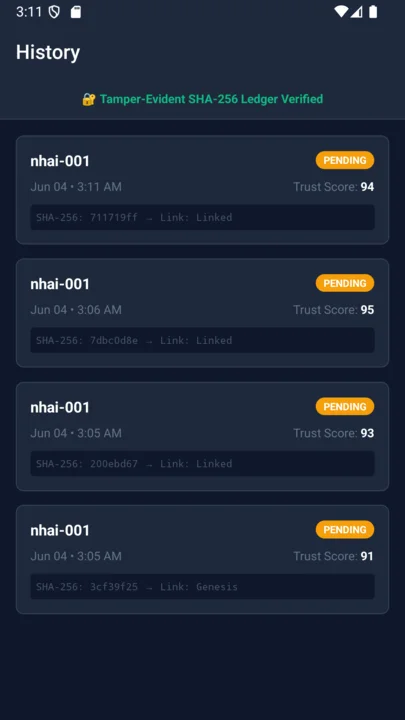
Every check-in is hashed into a SHA-256 chain, and the history screen verifies that chain before it renders anything — the banner reads tamper-evident SHA-256 ledger verified only after that check passes.
Each entry carries the record id, the timestamp, a trust score, the digest, and where the record sits in the chain — Linked for an ordinary entry, Genesis for the first one. Trust scores in the sample history run 91–95, so the score is a live signal rather than a constant, and the hash is what makes the sequence verifiable after the fact.
Sync
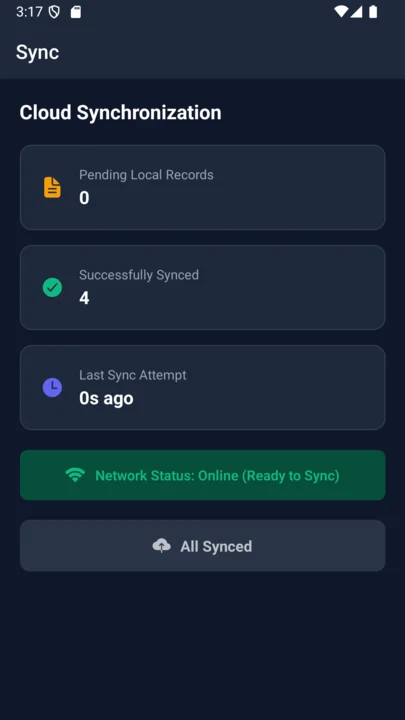
The sync screen separates the two states that usually get conflated: what is still sitting on the device and what has made it to the server. Pending local records, records successfully synced, when the last attempt was, and the network state — online, ready to sync — with an explicit All Synced action rather than a background spinner that pretends the work is done.
Contracts, not copy-paste
The mobile app and the admin dashboard are separate frontends, so the types that cross
between them are shared: zod schemas define the payloads once, and both sides validate
against the same definition. A field added to a check-in record reaches the dashboard
without a second hand-written type drifting out of sync.
Status
Repository link intentionally withheld until the project is made public.